01
The household changed.
The household that shaped postwar housing policy is no longer the default. More people now live alone, in smaller households, and across longer, less predictable life stages.
Field Guide 01 The Great Housing Reversal
A growing body of work about housing mismatch, civic life, and the neighborhoods we need next.
Figure–ground study
of the choices between
household and neighborhood.
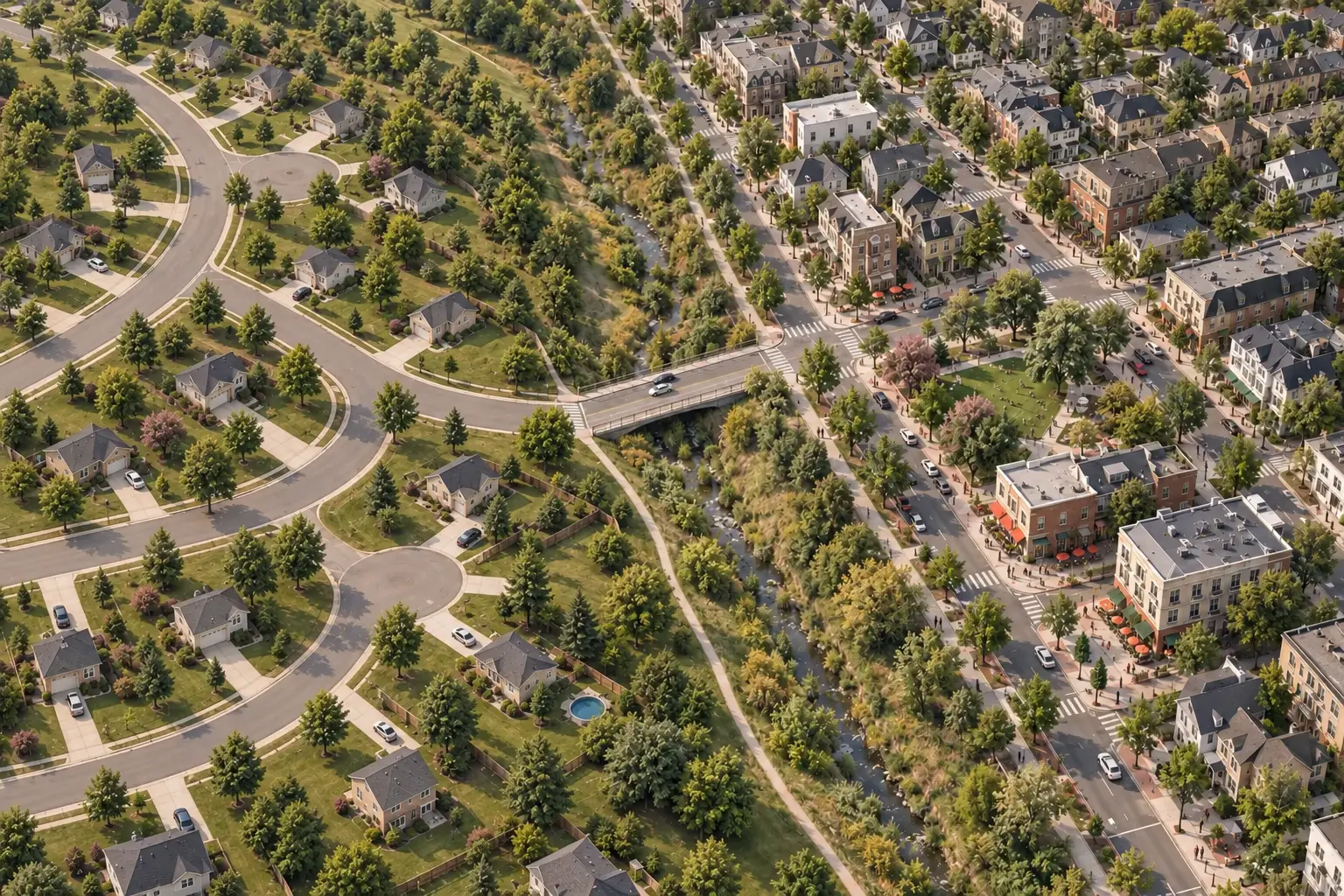
Households are smaller, older, and more varied.
The missing middle became truly missing.
Proximity turns private life into civic life.
The central argument
Housing is not simply failing to keep pace. It is failing to change direction.
The household that shaped postwar housing policy is no longer the default. More people now live alone, in smaller households, and across longer, less predictable life stages.
An atlas of ideas
01 / 05
The rules embedded in zoning, standards, and approvals that quietly determine what a place is capable of becoming.
Trace the idea through the workField notes & conversations
Essays, interviews, and foundational work—organized as one growing body of thought.
Community is not a decorative outcome added after the economics are settled. It is produced—or prevented—by decisions about land, form, access, and shared space made at the beginning.
Open essaySpeaking atlas
Topics can stand alone or be shaped into a connected program for civic leaders, developers, planners, builders, and housing advocates.
How development rules encode a community’s assumptions—and how healthy civic DNA makes room for adaptation without sacrificing coherence.
Why the housing crisis is not only about unit count, and which households and life stages the current system consistently fails to serve.
Moving from diagnosis to delivery through LAND–DESIGN–CODE, project gates, pre-approved patterns, and process-first implementation.
How streets, blocks, housing types, and daily destinations expand social bandwidth and turn proximity into durable civic capacity.
Resource index
The site is designed as an expandable shelf: practical frameworks beside the evidence that gives them weight.
Evaluate whether a place supports connection, resilience, and ecological alignment.
↗Reveal where codes and approval systems prevent the forms a community says it wants.
↗Align the three delivery systems that determine what actually gets built.
↗Discover what an existing place can preserve, adapt, add, reconnect, and transform.
↗Measure whether a gathering place can turn ordinary activity into repeated encounter and shared life.
↗Household composition and living-arrangement data from the U.S. Census Bureau.
↗Research on the tradeoffs people make between walkability, housing, and mobility.
↗A useful explanation of how residential zoning narrows the range of legal housing types.
↗Applied tools / working edition
These instruments do not replace local judgment. They make that judgment visible—so a project team can identify what supports the desired human habitat, what suppresses it, and where responsibility for change belongs.
PLACE / PERFORMANCE
Rate the place as it exists or the project as currently proposed. A score of 1 means the condition is absent; 5 means it is deeply embedded in the pattern.
The work ahead
“The question is no longer whether housing will change. It is whether we will shape that change toward more shared life—or allow the mismatch to deepen.”Return to the beginning